
 By
By
| CONTRACT | CLOSE | NET CHANGE |
|---|---|---|
| Dec '26 Corn | 523 | -5 1/4 |
| Mar '27 Corn | 536 1/2 | -5 1/2 |
| Nov '26 Beans | 1288 1/4 | -30 3/4 |
| Jan '27 Beans | 1303 | -29 1/2 |
| Dec '26 Chi Wheat | 688 3/4 | -14 1/2 |
| Dec '26 KC Wheat | 745 3/4 | -16 1/4 |
| Dec '26 Cotton | 82.86 | +.15 |
| Crude Oil (spot futures) | 92.34 | -.07 |
| US Dollar Index (spot futures) | 100.93 | +.22 |
| Dow Jones (spot futures) | 51,837 | -326 |
Daily Glance
With the Trump/Xi summit finally over, and details of the talks released, the markets gave a big thumbs down on the news. The bottom line is that although some trade deals were reported, as well as some clarification of alleged previous agreements, no concrete indications of new demand for our ag goods was seen and our markets reacted negatively.
Want the rest of today's comment?
Leave your name and email to read the full daily market comment, including technicals, weather and trade implications.
What was reportedly agreed to was a $30 billion dropping of reciprocal tariffs, and this included the US dropping the 10% duty on imported fentanyl in exchange for China dropping its 10% duty on the importation of many US ag goods. (Interestingly, this is the first time that China has actually acknowledged a trade deal in three actual summits.) While this tariff drop included corn and wheat (which now revert back to the previous existent tariff of 1%, the Most Favored Nation rate), it did not include soybeans, whose tariff remains at 10%. What this means is that only the Chinese government is likely to continue buying US soybeans, because the extension of the 10% tariff strongly suggests that all private Chinese companies will continue to buy their soybeans from South America.
Lots of number crunching going on, and our take on it is that the 25 MMT of soybeans that China has reportedly agreed to buy each year into 2029, now stands at approximately half done for this year, meaning that China will supposedly buy another 12-13 MMT of soybeans by the end of the year. Most or all of this is believed to already be in the USDA Supply Demand report's Export projection of 1.685 billion bushels. If this is the case, we would expect the main catalyst to changes in the soybean balance sheet will result from yield changes. The yield currently stands at 52.8, and early harvest results suggest this is likely fairly accurate. The current Ending Stocks estimate is 310 million bushels.
As for corn, months ago, Treasury Secretary Bessent claimed that China had agreed to buy $17 billion of ag goods exclusive of soybeans. The press releases from this latest summit seem to confirm that agreement was in fact made and based on export tallies to date, it appears as if China has already fulfilled something over $4-5 billion of this agreement, which suggests that another $10-12 billion of buying of various ag goods should happen by the end of the year. Just what the mix of that figure will be is critical, but it is expected to include some corn, wheat, sorghum, and cotton. Some put the potential corn buys as high as 5-15 MMT, but the upper end of that strikes us as an awfully rosy expectation. (The bushel equivalent of 5 MMT is about 200 million bushels.) The current USDA corn export figure is 3.275 billion, and the Ending Stocks estimate is 1.567. Most analysts feel that more Chinese corn buying is not included in the 3.275, so any new business would likely raise that figure and reduce the Ending Stocks estimate. Keep in mind also that early harvest results suggest that additional cuts to the lates yield estimate of 178.5 are likely. So...it seems likely to us that further cuts to the corn Ending Stocks estimate are more likely than not.
Back to the price action...corn managed to stay above Friday's low, and cut their peak losses in half by the close. But December still posted its lowest close since August 24.
November soybeans traded down to about a one month low, and posted their lowest settlement since August 28.
Outside markets were extremely volatile as well as rumors were all over the place, including one that Trump was ready to offer sanctions relief to Iran in exchange for Iran agreeing to suspend uranium enrichment, but this was denied by various sources and doesn't appear to be valid. However, crude oil retreated from a $4.13 peak gain to currently trading only 45 cents higher, suggesting something might be brewing. The Dow saw a peak loss of almost 600 points and is currently 320 lower. Bonds dropped to a new contract low, supporting the Dollar Index.
Key Points/Developments
Technicals: December corn had broken to the downside of its recent range on Friday, and today it managed to stay within Friday's range. The support at 525 was violated and support still exists at 515 and at 505, the 50 day average. Resistance is seen at 525, 530, and at 545.
November beans should see support near today's low of 1279-1280, and then its 50 day average at 1254. Resistance is seen at 1300, 1314, and the 1332 area, which has turned beans back three times this month, is still the resistance to beat.
Spreads: The Dec/Mar corn spread narrowed another quarter cent to 13 1/2. The Nov/Jan bean spread went back out by 1 1/4 cents to 14 3/4, with the recent runup in quick shipment basis backing off today, probably due to the forecast for things to dry out next week.
Weather: TStorm showed an uptick in corn and soybean weather conditions, now at Slightly Favorable, as forecasts finally look drier next week, and both Brazil and Argentina getting some very welcome rains.
Moderate to heavy rain affects an unusually wide area of hoe central / southern Plains, Corn Belt, and mid-South through late week, but an extended period of dry and mild weather follows to allow for rapid wheat planting and corn / soybean harvesting starting around 10 days from now.
In South America, widespread coverage of near- and above-normal rainfall is ahead over the next 14 days, which will: 1) encourage soybean planting in central Brazil, 2) keep first-corn and wheat in Brazil unusually wet into at least mid-October, and 3) improve soil moisture for wheat development in Argentina (while aiding dry first-corn and sunflowers).
Markets/Trading Implications
Not what we wanted to see after all the hype and expectations surrounding the Trump/Xi summit. It wasn't really negative news, more an absence of solid new positive news, and this deflated some of the risk premium that had built up as the summit approached. In addition, the positive turn in South American weather was another negative for prices, as the El Nino talk (and hype!) had generated a lot of bullish enthusiasm.
Today's action, along with the already started retreat from recent highs, has shifted the market's mentality to more of a "prove to me it's still bullish" posture, and that will likely take some time to either happen or not.
A lot of variables remain unknown, most importantly what the final yields will be (as said above, corn is the most likely to be clipped some in our opinion), what China actually steps forward to buy by the end of the year, and perhaps most importantly, how committed are the funds to their extremely large long positions (soybeans longs are record high). Typically, the funds are not spooked out of a position from one news headline, and the way we firmed from today's session lows might suggest that is the case this time. But with harvest picking up quickly, and the accompanying harvest pressure, it makes the funds' actions more critical and impactful than ever.
The trend remains higher for both corn and beans, and both remain above their 50 day averages, corn by 18 cents and soybeans by 35 cents. Let's watch the action over the next several days for those markets' ability to stay above those important levels, and to see if some new tangible business comes from China.
Call anytime.
Other Notes
- Crop progress shows corn harvest advancing by 5% to 18%, which is the 5 year average pace. Soybean harvest also advanced by 5%, now at 17% complete.
Good/excellent ratings were unchanged for both with corn at 57% (66% year ago) and soybeans at 58% (62% year ago).
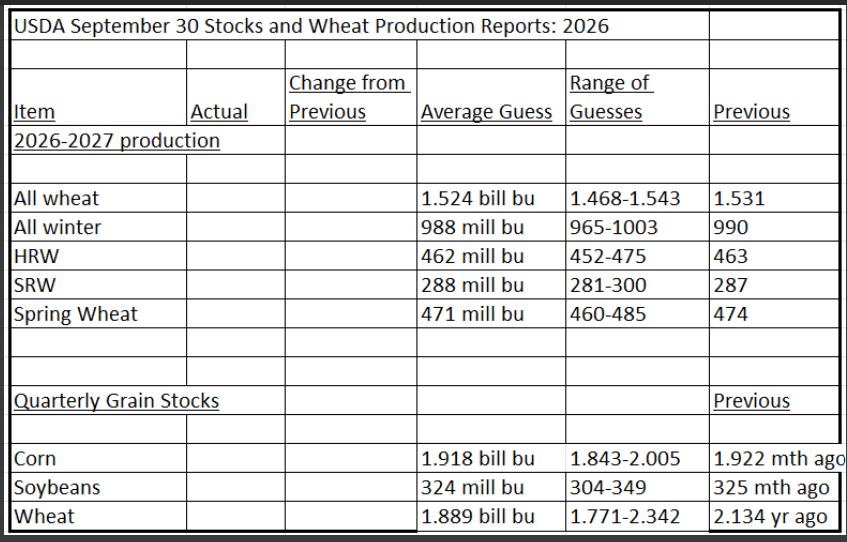
- Wednesday brings on the quarterly stocks report. Below is a summary of the average trade guesses:
Static Notes
- Commitment of Traders data covering positions through Tuesday, September 22, showed the funds moving back into beans while trimming corn. Corn's net long came down 12k to 414k. Soybeans' net long grew 20k to 265k, and wheat's net short deepened from nearly 5k to 13k.
- Prices during the corresponding week saw December corn gain 1 cent, November beans gain 6 3/4, and December Chicago wheat lose 11 1/4. In the three trading days since this report, corn has lost 8 1/2 cents, soybeans have lost 6 1/2, and Chicago wheat has lost 14.
Have a great weekend!
Clayton and Taylor
RISK DISCLAIMER:
Trading in futures products entails significant risks of loss which must be understood prior to trading and may not be appropriate for all investors.
Please contact your account representative for more information on these risks. Past performance of actual trades or strategies cited herein is not necessarily indicative of future performance.